I understand the impulse to say "nothing's impossible". We've been raised on stories about heroes triumphing over impossible odds. Our scientific understanding of what's possible has greatly expanded in the last couple centuries. Things once thought impossible have become possible at historically unprecedented speed. "Nothing's impossible" is a good heuristic, because if someone tells you something's impossible, especially someone with a lot of power, it's probably because they don't want you to try.
But like all good heuristics, this can be harmful when followed dogmatically, or taken to an absurd extreme. Some things really are impossible, or so unlikely they're not worth thinking about. And thinking otherwise can lead us to act against our own self-interest.
Say you roll a six-sided die. What are the odds that you'll roll a 17? I can tell you with confidence that the odds are zero. I can bet you a billion dollars that you won't roll a 17. Even if you can roll it hundreds of times a second, I don't have to worry, because I know rolling a 17 is impossible.
|
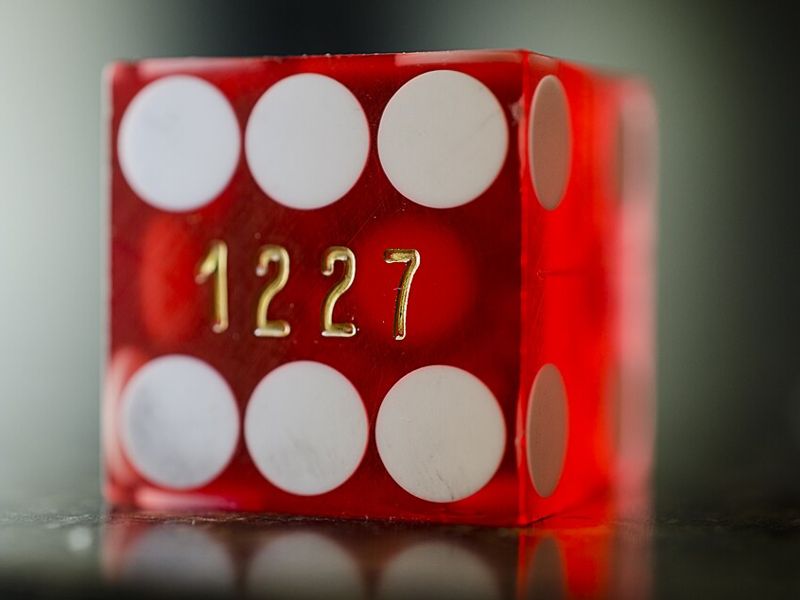
| Close, but no cigar. Close-up photo of a translucent red casino die. The 6 face is visible, and the number 1227 has been stamped between the two rows of pips. CC-BY 2.0, r. nial bradshaw. |
There are folks who would argue with me, and insist that rolling a 17 is just very unlikely. They might give it a probability of a decimal point followed by some ungodly number of zeroes and then a one. "Maybe magic exists," they'll say; or maybe they could pray to God to change one of the faces to 17; or reality could fracture and we could all end up in a splinter timeline where the die is a misprint, or six-sided dice are numbered 14-19 for some reason.
But no. None of those things will happen. I can't "prove" they won't happen, because onus probandi, but it's obvious that we gain nothing by remaining open to these possibilities. I love The Hitchhiker's Guide to the Galaxy too, but I promise the infinite improbability drive was just a joke.
Pascal's Wager
Believing impossible things isn't inherently harmful, of course. Plenty of people benefit from religion or spiritual beliefs without negative consequences. Take Pascal's Wager:1 we can accept that there is no God, but what if we're wrong and Hell is real? An eternity of suffering would be a hefty price to pay, and we can avoid it for the relatively low up-front cost of believing in God. Even if the odds of Abrahamic religion being true are one in a trillion, isn't it better to believe, just in case? It's not like it costs us anything.
And if it's just a matter of saying "I believe in God" and getting a permanent get-out-of-Hell-free card, then Pascal has a point. If you plan to live your life as you otherwise would except for a miraculous deathbed repentance and conversion, that's just fine. You might look a little silly, but pretty soon you won't have to worry about it. Go with God, as they say.
But it's never that simple, is it? This isn't a satisfying conclusion, because accepting the existence of God comes with serious implications. If you decide to believe in God, that would require also believing that He's all-powerful and all-knowing, because otherwise what are we even talking about? And if that's true, it follows that God will know your deathbed conversion is insincere and send you to Hell anyway. In fact, you'll go to extra Hell for the additional sins of bearing false witness and taking the Lord's name in vain. The sensible thing is to drop the whole thought experiment because it's just a bit silly.
But maybe you're still really worried about Hell. Humans don't have a great intuition for large numbers or probabilities, so maybe the mere idea of eternal suffering being possible is enough to keep you up at night. You might buy into Pascal's Wager and, to be certain, start living a life that would instill in you a genuine, sincere conviction of God's glory. You might want to make absolutely sure He can't accuse you of faking it.
This is a dangerous path to go down, because there is no way to be absolutely sure. The best guidebooks we have are full of false and contradictory statements. People who claim to know what God wants say different things about what it takes to get into heaven. How do you know who to believe? What if you follow Christianity to the letter2 but it turns out that Islam was the actual truth? What if Judaism had it right all along? And what if you're way off base, and get reincarnated as a worm because you didn't work on your karma? These are mutually exclusive beliefs, you can't bet on all of them. If you put 50 on red and 50 on black, you just end up back where you started.
So maybe, to compensate for the uncertainty, you pick a belief system that speaks to you and go hard. You become really invested in your new religion. Suddenly Pascal's Wager seems like a lot more than you bargained for. What starts as a small investment of belief could, if you follow it to one of its many logical conclusions, derail your entire life. It's hard to predict how our brains will adapt to new self-imposed belief systems. Sure, some folks don't worry about it too much, they'll go to whatever church is down the street, tithe 10% of their income, and figure that ought to be enough to prove their sincerity to God. But some folks might end up flying airplanes into buildings.
I think accepting Pascal's Wager is a lot more dangerous than rejecting it. If I start making myself believe in things that aren't real, there's a big risk it'll substantially change my life for the worse. I probably wouldn't do any Nine Elevens, but I could very well sacrifice a huge number of quality-adjusted life years in fruitless search of some unattainable certainty.
There are a lot of things I want to do, and I only have one very limited and precious lifespan in which to do them. My time management skills already suck. Do I really want to volunteer for more pointless obligations? Going to church? Praying X times a day? Building temples? Memorizing rules about what I can eat and when? Washing all the special undergarments I need to start wearing? Saying hundreds of Hail Marys? Spending hours arguing with people who believe something different?
No thanks. I think I'll take the trillion on this one.
Understanding small chances
I think "unlikely things aren't worth worrying about" is something most people believe unconsciously, and the evidence is that most of us go outside. Did you know we all have about a 1 in 15,000 chance of being struck by lightning at some point in our lives?3 That's way more likely than some things people worry about, but most of us don't refuse to go outside when it's raining. We don't worry about many unlikely things that might happen when we venture outdoors: meteorites, falling space debris, being swallowed up by sinkholes, bear attacks, freak skydiving accidents, Mothman. The people who do are encouraged to get help with their anxiety disorders.
But sometimes our intuitions fail us. A fact oft-cited to help ease flight anxiety is "you're more likely to die in a car crash than a plane crash". And this is true, by a huge margin: in 2024 one in 101 preventable deaths were caused by motor vehicle crashes, while the odds of dying in a plane crash were too small to calculate.4
But people don't usually find this comforting, and fear of flying remains much more common than fear of riding in cars. I think this is because car deaths have become so normalized that, like lightning strikes, they're just a background fact of life. Plane crashes are uncommon enough that when they do happen, it makes the news, while car fatalities happen too often for us to really process. If the news reported every time someone died in a car crash, that's all we'd ever hear about, and we'd be terrified to go anywhere near a motor vehicle. But they don't, so we aren't.
So the odds we think something will happen seem to be highly correlated with how often we think about it. This tracks with how people talk about crime: despite crime statistics steadily going down, people feel like crime is becoming more likely because they hear people talking about it more. It also tracks with how I see techy people and nerds talk about AI doom and foom:5 they'll massively over-inflate the probability based on vibes,6 or if they're "skeptical", they might give a 1% chance of it happening┈but paradoxically behave as if the outcome is almost certain. And it's easy to understand why: if the people around them are constantly talking about AI eschatology, and they don't make an active effort to correct for this bias, they're going to start feeling in their bones that AI will probably save us all or kill everyone.
If a person┈even an enlightened polymath like Blaise Pascal┈grows up in a culture where everyone is preaching fire and brimstone, Hell is going to be on his mind. If Pascal was born into a mostly secular society, he might've heard about Hell from an eccentric street preacher, but instead of thinking up his Wager he would've given it the same amount of thought that we give to eccentric street preachers today, which is zero.
Pascal's Yahtxxee
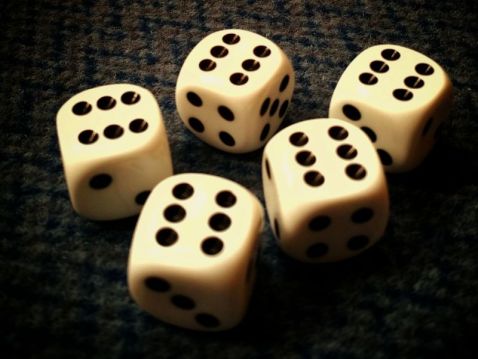
Suppose you decide that, rather than playing Yahtzee for score, you want to try to roll as many natural yahtzees as possible. A "natural yahtzee" is when all five dice land on the same number in a single roll.
|
| Artistically-lit photo of five 6-sided dice, all showing a roll of six, on an upholstered surace. CC-BY-SA-4.0, Кирилл Купцов. |

The odds of this happening are 6⁻⁵, or 1 in 7776. A game of Yahtzee has 13 rounds, and you get 3 rolls per round, so with 39 rolls you should expect to see a natural yahtzee about once every 200 games. If you play one game every day, odds are you'll get one natural yahtzee every 6½ months or so.
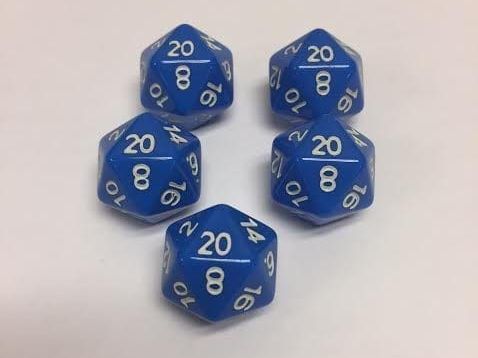
Now imagine you're playing Yahtxxee, a fictional variant that uses five 20-sided dice. The odds of getting a "natural yahtxxee" are 20⁻⁵, or one in 3,200,000.7
|
| Product photo of five blue 20-sided dice, all showing a result of 20, on a plain white background. Via Badger Games. |
Our poor intuition for large numbers and probability makes it difficult to grasp how much less likely this is. Five dice is a small enough number for many people to subitize, i.e. perceive without even needing to count. 20 is about 3x more than six, which doesn't feel like a massive leap: it's still small enough that it's trivial to count to. On a gut level, it doesn't feel like a massive difference. But if you play one game of Yahtxxee every day, you shouldn't expect to see a natural yahtxxee for at least 302 years. It's not just three times less likely, it's nearly three orders of magnitude less.
Now I'm going to offer you a bet: roll five 20-sided dice. If they all land on the same number, I'll give you a billion dollars. (Pretend I have a billion dollars.) If they don't, you have to give me a dollar. Should you take the bet?
Well, it depends on how many dollars you have. If you can afford to lose $3,200,000, then absolutely. A billion dollars? That's more than a 300:1 return. The expected value to you would be very high.
But most people reading this aren't multimillionaires, so the calculus is quite different. I would argue that you shouldn't take the bet, even if you think it's legit, even if the offer is from Carlos Slim8 himself.
This is counterintuitive to a lot of people, because the investment is so low and the potential payout seems so high. Rolling a yahtxxee feels on an emotional level like something that could happen. All five dice landing on the same number is something many of us┈many of us with experience rolling D20s, anyway┈can picture in our mind's eye. Sure, it probably won't happen, but are you really going to throw away a chance at a billion dollars to save a lousy buck?
I would. Well, I'd refuse the bet: I wouldn't call it "losing a chance at a billion dollars" because it isn't one. I'm not going to win. The odds are close enough to zero that I can treat them as zero.9
And I wouldn't refuse because I need to save the dollar, I'd refuse because accepting would be undignified. Carlos Slim doesn't need my dollar; the only reason he'd offer this bet would be to taunt me: to have a quick laugh at the expense of a stupid poor person with an impossible dream.
Accepting could also be bad for my mind. Remember that accepting Pascal's Wager would mean taking the possibility of Heaven at least a little seriously, and thinking about Heaven would make me more likely to seriously want to get there.
By the same token, accepting Pascal's Yahtxxee means taking the possibility of winning at least a little seriously, and thinking about winning might make me seriously want to win. Seriously wanting to win would increase the danger of falling for gambler's fallacies. By how much, it's hard to predict, but why take the risk?
What if I roll the dice and three of them land on 7, the number of good fortune? 🎰 I won't win anything, and logically I understand this is a meaningless coincidence that gives me no greater chance of winning if I try again, but when I see those 7s, thoughts of winning will fill my head and give me a rush of adrenaline. When that happens, I won't be thinking the cool, logical thoughts I have when it's just a thought experiment. My reasoning will become clouded. I might want to try several more times, or if I'm unable to bet again, I may seek other forms of gambling, rationalizing it by asserting that rolling three sevens "must be a sign".
Even if I tell myself that it's just for fun, or I'm "doing it for the meme", it would be an actual compulsion, a surrendering of my free will, because my brain's secret motivation would be to chase that adrenaline high. If I don't get another one, I might sober up and cut my losses, but if I get a few more "almosts", I might seek even more extreme forms of risk-taking. One outcome fills me with despair (as the adrenaline rush wears off and the crash sets in); the other outcome intensifies a self-destructive cycle. It's best to avoid the situation entirely.
If you're sure this could never happen to you, that you have too much willpower to fall for such an unsophisticated trap, you're exactly the kind of sucker the casinos and betting apps and crypto scammers and retail investment platforms of the world are looking for.
Pascal's Nation
I live in the United States of America, the land of the temporarily embarrassed billionaire, and gambling is the air we breathe. Capitalism is our religion, and "big risk, big reward" is less investment advice than mantra. Our saints are billionaires, whose wisdom we study with uncritical reverence. Money is virtue, and whoever has the most money is axiomatically the most virtuous. The rich got rich by "being smart" and "working hard" and "taking big swings", and anyone who wants to get closer to God is encouraged to do the same.
But, like in our hypothetical Pascal's Yahtxxee scenario, these people won because the system is rigged in their favor. The way to get rich in the US is by already being rich. The rich have enough money to make enough bets that one of them will go their way, and make up for the ones that don't. Ordinary people are encouraged to play the same game, but we don't have the plot armor that wealth provides. We have nothing to gain and everything to lose.
Some folks will point to billionaires who "started with nothing", like Mr. Beast, and decide they want to do that too. "If it was possible for him, it's possible for me," they might think. This is another gambler's fallacy.
Remember that getting a yahtxxee isn't literally impossible; the odds are one in 3.2 million. If 3.2 million people roll five D20, one of them will probably roll a yahtxxee. On a long enough timeline, it becomes inevitable.
But the sense in which this is possible doesn't apply to our individual lives. We can see a smaller-scale example of this with the "Birthday Problem". The odds that any random person will have the same birthday as you are pretty low, 1 in 365. But get enough people in a room and the odds that any two of them were born on the same day go up pretty quickly; you only need 40 people in a room before the odds that two of them share a birthday go up to 90%.
But if you're in that room, the odds of you having the same birthday as a random other person in the room are still 1/365. The odds of a thing happening to someone at some time isn't information you can use to make personal decisions.
This doesn't mean you definitely shouldn't try to be the next Mr. Beast;10 if you like making youtube videos, you should make youtube videos. But if you pin all your hopes and dreams on reaching that level of success, it's not going to go well for you.
Even if you consciously reject the money ideology, even if you hate billionaires, even if you wouldn't piss on Elon Musk if he were on fire, even if you're an enlightened polymath, it's hard not to think about Heaven and Hell when the gospel is all around you... especially when you feel cut off from any other source of salvation you might once have had hope for. You might be convinced to roll the dice, just once. How much harm could it do?
And maybe you're right. Maybe you'll roll the dice, lose, and move on with your life.
Or maybe you'll lose your ability to say no. Maybe, no matter how much you wish you could just live your life, once you start thinking about Heaven and Hell you won't be able to stop. Is it worth the risk?
God Money don't want everything, he wants it all. If you bow down before the one you serve, you're going to get what you deserve.
-
But, y'know, don't take it. ↩
-
Assuming for the moment that differences between western orthodox, eastern orthodox, catholic, baptist, anabaptist, anglican, evangelical, lutheran, methodist, moravian, pentacostal, quaker, unitarian, adventist, mormon, swedenborgian and gnostic interpretations are unimportant, and that simply "being Christian" is enough to get into heaven. ↩
-
Per the US National Weather Service. ↩
-
Per the National Safety Council. All data is US-only. Statistics are confusing, so I should clarify that this doesn't mean you have a 1% chance of dying in a car crash; it's saying that if you die a preventable death in a given year, and the year is similar to 2024, then there's a 1% chance the cause of death will be an auto accident. The NSC is giving relative probabilities, while the odds in the lightning strike statistic are absolute. ↩
-
"Foom" is the opposite of doom, the idea that an AI will become super-intelligent and lead us all to a rapture-like future. From onomatopoeia for an explosion. (Wiktionary) ↩
-
A lot of AI true believers will justify their inflated odds with something called "Bayesian inference", which in this case means instead of only pulling one number out of their ass, they'll pull ten numbers out and multiply them together. ↩
-
Fun fact: still 100x more likely than winning the Powerball. ↩
-
My example billionaire only because his name is the most fun to say. ↩
-
Amendment: this is a decision I can make for myself, but I remembered I should make reasonable hedges against improbable things if they might negatively affect others. See Almost fell into a Well, Actually. Note that this doesn't mean AI doomers are right, because fire is a real thing that happens sometimes. Eschata are measured on a different scale, because they must be, because otherwise the logical endpoint would be spending all our time and resources hedging against a million hypothetical doomsdays. That's no way to live a life. ↩
-
Well, there are serious ethical and philosophical reasons why you shouldn't, but I'll just focus on probability here. ↩
I am glad this didn't need to mention basilisks that have only hurt people with obsession disorders in the EA community.