I knew it was legal to sell fake medicine in the US. It sucks, but "homeopathy" has been around forever here, and the "medicine" is just sugar pills, so it's not going to actively hurt anyone (outside of scamming them out of a few dollars.) Our government decided banning them isn't a hill worth dying on, so these fake remedies have been grandfathered into the culture. I accept this.
What I didn't know is just how lax the regulations are for selling such a product here. I had never looked closely at a "homeopathic" product, but I assumed they'd have a big ol' disclaimer box like the one you see on dietary supplements:
These statements have not been evaluated by the Food and Drug Administration. This product is not intended to diagnose, treat, cure or prevent any disease.
Most people in the US are probably familiar with this warning, because there are supplements that have a legitimate use. I have some melatonin that I use when I think I'm going to have trouble sleeping. If I'm exhausted on Friday night and I sleep in til 10 on Saturday, It's probably going to be hard to get to sleep at a reasonable hour that night. I don't want my sleep schedule to get out of whack, so I'll take a 1mg melatonin tablet about an hour before bed. It really works, it makes me tired enough to fall asleep when I want to; but there's no reason to regulate it as a drug because, physiologically speaking, it's basically inert. There's no lethal dose of melatonin, and the worst side-effect you're going to get is exceptionally weird dreams, and you mostly only have to worry about that if you take too much.1 (Some people get nightmares, but my weird melatonin dreams are usually kind of fun.)
Some supplements you can buy are pure snake oil, because the FDA will let you put whatever you want in a capsule and sell it as long as it won't hurt people. But all supplements, even the useful ones, must have the disclaimer and follow some strict label laws. You're not allowed to make direct claims about the efficacy of a supplement, even if it's fairly well-supported. So with melatonin, you can't say "this will help you fall asleep", you have to use weasel statements like "helps support restful sleep". This is a good thing. You don't want grifters making false statements about random herbs and spices.
I always assumed the label laws were similar for "homeopathic" products, maybe with a more strongly-worded disclaimer. But I watched a video by Grant Harting (a licensed pharmacist in four states) about a fake flu remedy, and I was blown away by how misleading the package is:
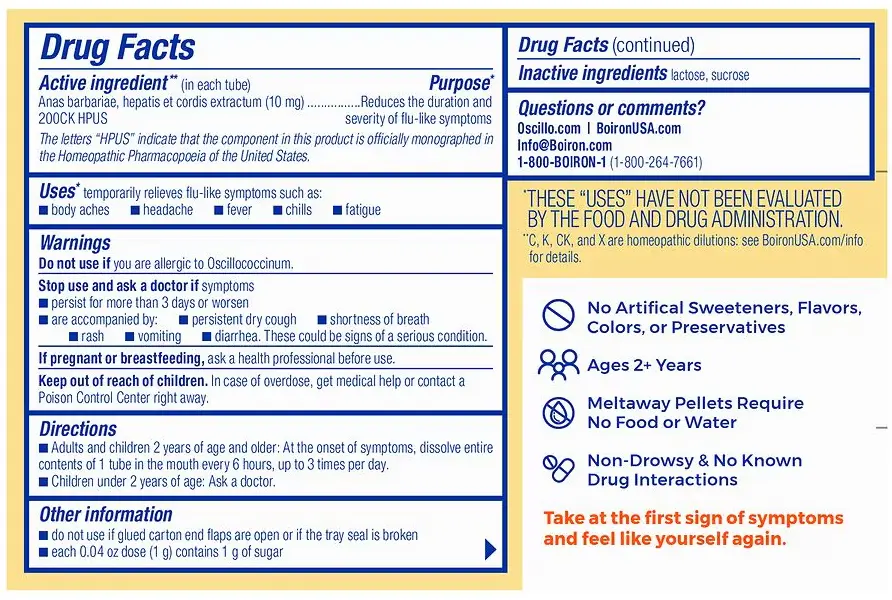
The "drug facts" box looks exactly like one you'd find on real medicine. On real medicine, this box is legally mandated and contains useful information; here, it's just cosplay. They shouldn't be allowed to use the word "drug" at all in relation to this product, in my opinion, because it only contains sugar.
If you don't read too closely, you'll be fooled into thinking it contains 10mg of some fancy Latin-sounding thing, but every part of this statement is designed to mislead you. "Anas barbariae" is a phrase that only appears on "homeopathic" products. Anas is Latin for "duck". Barbariae is a faux-Latin back-formation of the word "barbary".3 "Barbary duck" is an alternative name for the Muscovy duck, a species of anatinae native to Central and South America. The real Latin name of this animal is Cairina moschata.
Okay, so something from a duck. "Hepatis et cordis extractum." means "liver and heart extract". Why is this part in Latin? Why wouldn't they just put "Muscovy duck liver and heart extract"? Well, it's to trick people into thinking the product is medicinal. "Liver and heart extract" sounds like something you'd buy from a witch doctor or Elizabethan apothecary. Latin can make anything sound legit.
Of course, the "200CK" after it means the product doesn't actually contain anything of the sort. Here's an analogy, per the explanation given on their website:
Imagine you put a drop (1mL) of red food coloring into a glass containing 100mL of water and mix it up really well. You'll have red water. Now dump out almost all of the red water until you only have 1ml of the mixture in the glass. Then add 100mL of water and mix it up again. This is already a very weak dilution; if it's high-quality food coloring, the water might still have a slight pink tint. Now dump out 100mL of the mixture and add 100mL of water. There won't be enough of the red coloring left to be visible. You pretty much have plain water again at that point.
Now do this 198 more times. That's what "200CK" means.
The good news is, if you were concerned about the health effects of consuming duck liver and heart extract, you don't have to worry. There isn't any left. The bad news is that you're spending your money on a tablet full of sugar. The label even makes this clear in the Other Information section: "Each [1g dose] contains 1g of sugar." That doesn't leave a lot of g for anything else. In fact, it doesn't even leave any micro-g. 1g−1g=0g.
So, let's go back to the melatonin. This is a product that actually has an ingredient that does something, but they're still not allowed to call it a drug or claim it'll have a direct effect. Despite being safe and effective, it still has to be labeled a supplement and given a big disclaimer box. So why the heck is the Boiron company allowed to call their product a drug and claim that it'll treat the flu?
I do like that the FDA disclaimer puts "uses" in sneer quotes, but to me this is a much less effective deterrent than the labeling requirements for supplements. I don't understand how they can get away with this. I understand why they're allowed to sell it—I disagree, but I get it—I don't understand why they're allowed to lie through their teeth.
Some folks will defend homeopathy by pointing out the power of the placebo effect, and yes, it shouldn't be discounted, but we have better placebo treatments for cold and flu: products like Airborne and Emergen-C. Zinc and Vitamin C supplements that have a speck of evidence that they might do something. Are they actually doing anything? Probably not, but Vitamin C and Zinc are at least nutrients needed by the body, and these supplements are no more expensive or dangerous than the fictional stuff.
I bet they're more effective placebos, too. I don't know about you, but I'm much more likely to believe in the healing power of vitamins and minerals than the long-lost ghost of a hypothetical molecule some guy claimed to find in a duck's liver a century ago. Neither of them is medicine, but I'll go out on a limb and say I think the duck liver one is a bit more far-fetched.
Secret comments update
I've probationarily re-enabled comments. I'm curious to see if having them disabled for a couple months have taught the spammers to leave me alone for awhile. All the previous comments are still there, which is good. I wasn't sure if that'd be the case. If you're not a spammer, feel free to leave a comment.
-
There's been a trend of supplement companies selling higher and higher doses of melatonin, and I really don't get it. The right dose for adults is about 0.3–1mg, and higher doses aren't going to do anything but make you more likely to have fucked up dreams. You can find doses up to 10mg in stores (and up to 25mg if you order online!2) When I first started using melatonin in the mid-00s, doses were represented in micrograms. It's important to be careful and do your research with supplements, because even the useful ones can be radically misrepresented. ↩
-
I've since learned the aforementioned YouTube pharmacist has a video covering a 120mg melatonin supplement. ↩
-
I'm familiar with this concept as a West Virginian, because our state motto also uses faux Latin: Montani Semper Liberi, or "mountaineers are always free". You won't find the word "mountaineer" in any ancient Roman text, but montani is a logical derivation of the word for "mountain". I'm not opposed to this sort of thing in general, but I definitely am opposed when it's used to make fake medicine sound more legit. ↩