Note: The literal first pause button was probably on a tape recorder in the 1930s or 40s, but this post is about video games.
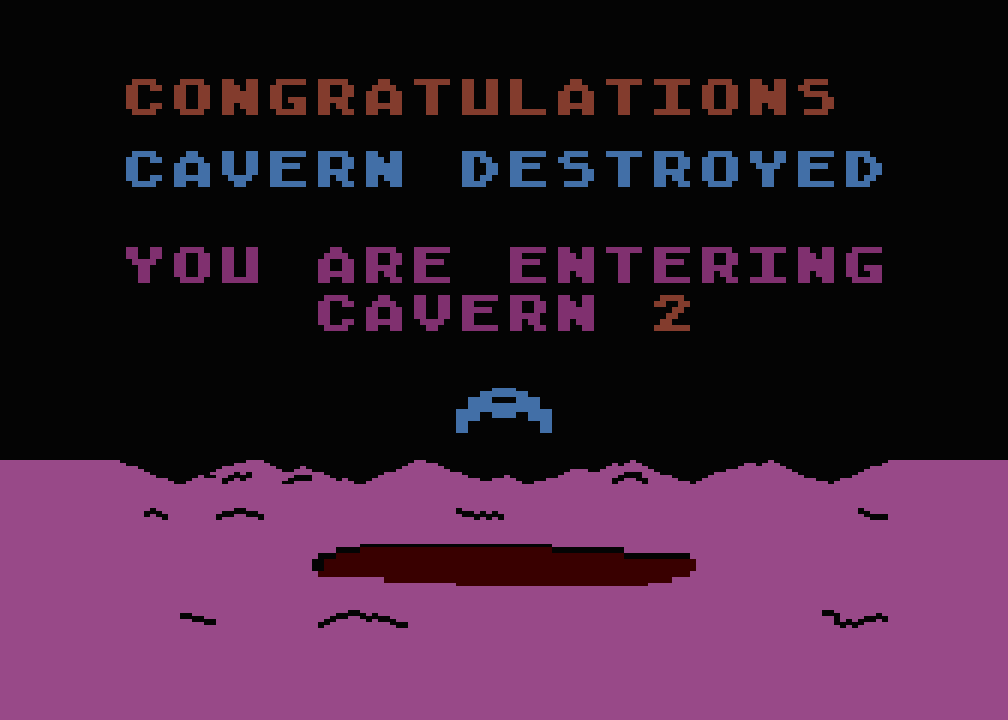
I was playing some Caverns of Mars for the Atari Home Computer and noticed, through trial-and-error, that you can press the H key (for "hold" or "halt", I expect) to pause the game.
I thought this was nifty. Caverns of Mars came out in 1981, so it was still early days for video games: they had barely had a single year in which to have come a long way since Pac-Man, and the presence of a pause function was in no way a guarantee. Arcade games couldn't give players a pause button, because any time the game wasn't being played would eat into the arcade operator's bottom line. Computer games of the 70s rarely had a need for one: most of them were still text-based, so were effectively "paused" any time they were waiting for the player's input. The early arcade ports typically followed the conventions of their older siblings.
Caverns of Mars was an arcade-style game that was original to home computers: you played with a joystick, but you also had a full keyboard to work with for functions like starting the game, changing the options, and yes, pausing the action. It was a nice feature!
 |
| Fuck Mars. 🖕 |
And that got me wondering: what was the first game that allowed the player to pause? The Atari 2600 didn't have a dedicated pause function, and with its single-button controller, it wasn't an affordance games could provide in software.1 And as far as I knew, none of the early consoles were fundamentally that different.
I expected the first game that allowed you to pause would be something for early home computers of the late 70s, probably the Atari or Apple ][, that offered an original arcade-style experience. I thought 1979's Star Raiders was a likely candidate, since it was in some ways the "mother of all demos" for video games.
Well, I won't keep you in suspense: The first games with a pause function were Hockey and Tennis, the games built into the Fairchild Channel F, released in 1976, predating the Atari 2600 and the "big three" home computers of 1977.2 One of the four multi-function buttons on the console was a pause (or "HOLD") button designed to allow you to adjust the game options even in the middle of the action.
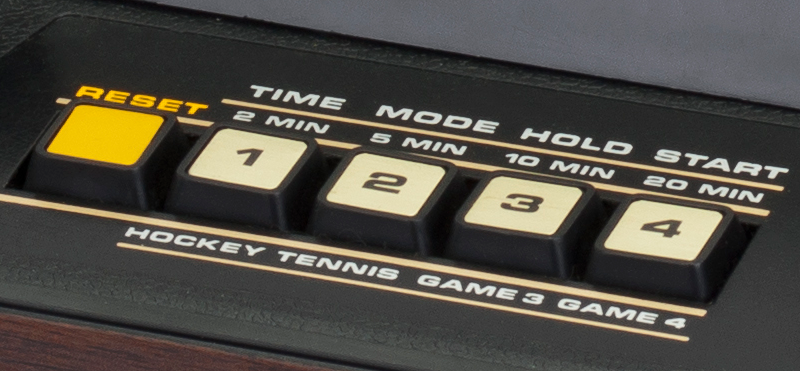 |
| Need to take a break? Simply press the Hold/10 min/3/Game 3 button. |
That's right, the Channel F, the first console with changeable game cartridges, the first one to use a microprocessor, the first one to offer player-versus-computer head-to-head games, the first one to offer color graphics;3 it was also the first one forward-thinking enough to allow the player(s) to pause the game. And Jerry Lawson, unsung hero of video games, was the mastermind.
The next console to offer a dedicated pause function, as far as I can tell, was the Intellivision in 1979. Its weird keypad-based controller allowed it to use a button combination (1+9 or 3+7, i.e. any two opposite corners of the grid) to enable "Intermission Mode". Interestingly, this seems to have been in response to an FTC complaint about CRT burn-in. The intermission mode wouldn't just pause the game, it would also blank the image, turning the entire screen the background color of the current game until unpaused. You can read an internal memo about the development of this feature at papaintellivision.com (PDF), a site dedicated to the memory of David Chandler, another unsung hero: the inventor of the screen saver.4
Remember, whatever technology we take for granted today, whatever seems obvious and inevitable in hindsight, someone had to have been the first person to think to do it. Many of these names are unknown to us. We owe it to people like Jerry Lawson and David Chandler to remember them and their contributions. The system likes to attribute all progress to the system, or a corporation blessed by the system, or a single mythical visionary leader recruited to represent the system. But real change comes from people like us, people with the power to think that maybe things can be different. We must remember the ones who did, and we must never let them take that from us.
-
Secret Quest, an extremely late 2600 offering (released in 1989, after the second and third-generation Atari consoles were out!) cleverly repurposed the vestigial
COLOR/B&Wswitch to bring up a sub-screen, pausing the main action of the game. As far as I know, it's the only one. ↩ -
The Atari 2600, the Apple ][, the Tandy TRS-80 and the Commodore PET all debuted in 1977. It was a crazy year. ↩
-
As far as I can tell, anyway? Every home console before the Channel F was Pong or a Pong clone,5 and none of them seemed to offer color outside of plastic overlays you could stick on your TV; but there were literally a thousand of these consoles and they're almost impossible to differentiate. If you know of one that offered color prior to 1976, please let me know. ↩
-
Among many other accomplishments. If you're into video game history, take some time to peruse papaintellivision.com, it's a fascinating archive. ↩
-
But since Atari just copied a game on the Magnavox Odyssey, maybe we should call them Table Tennis clones. ↩