It wasn't always like this. In the early days, video games were for everyone. Games like Pong and Space Invaders could be enjoyed by players of any age. Pac-Man fever wasn't only an affliction of the young and old, everyone was susceptible. If anything, early arcade games were more likely to be played by adults, because you were more likely to find them in smoky bars than any place a child might hang out. They were a natural extension of the nickelodeons, love testers, pinball machines, and other coin-op amusements found in such places for most of the 20th century.
Then something happened, and video games became a pastime that was widely understood to be "for children". There was some market segmentation: computer strategy games and RPGs could be for adults, because they were cerebral, like chess. Read some old issues of Computer Gaming World or its contemporaries and you'll find reviews dripping with derision for any game with an action component, dismissed as a simplistic game for children because it relies on reflexes, pattern recognition, and quick thinking—as opposed to games requiring "intelligence" (whatever that is.)
But this can't be the whole story, because if computer strategy games and RPGs are chess, then the real-world analog to Nintendo would be baseball; and it's probably true that more kids play baseball than chess, but still, very few people would describe baseball as "a game for children".
I think one factor is that companies wanted to distance themselves from the bad reputation of the aforementioned smoky bars. Early arcade games got some heat from the Moral Outrage Squads because of their superficial resemblance to gambling machines. It doesn't help that the original "pinball machines" were a form of gambling, games of chance more like pachinko than the flipper-based game we're familiar with today; so if you pointed to pinball machines and tried to argue that video games were also just for fun, that didn't help, because pinball machines already had an unwarranted bad reputation.
True, anyone with a brain could put a quarter in a slot machine and a quarter in a Space Invaders machine, and immediately understand that video games weren't like gambling at all, but it's like it was impossible to believe that an adult would spend money on a coin-op machine just to have fun. It must still secretly be gambling, somehow.
So maybe arcade distributors wanted to pivot from smoky bars to bright, colorful arcades purely so they could say "okay, now it's a fun activity for kids, so therefore it can't be gambling." And well, we can look to Fortnite and Roblox to see how well that theory panned out.
Still, I can't shake this feeling that video games didn't become taboo for adults until they entered the home. I can picture a working professional unwinding after work with a couple games of Space Invaders, or Asteroids, or even a colorful and whimsical game like Pac-Man. Maybe in a smoky bar, but maybe in a convenience store, restaurant, movie theater, bowling alley, etc. Arcade games could be anywhere and for everyone.
What's harder to picture is a middle-class professional unwinding after work, at home on the couch, with an Atari 2600 joystick in their hands. The marketing for early home consoles was very family-oriented, so they weren't excluding adults just yet—the 2600 and its peers were sold as wholesome family entertainment, something parents and kids could do together, the same category of activity as board games and lawn darts. So companies saw adults as part of their marketing strategy, but they excluded the kind of young urban professionals who might've been way into arcade games.
In reality, I think even parents were only buying the consoles for their kids, and most adults had zero interest in them.1 The reason I think this is simple: Atari 2600 games sucked ass. They were generally hideous and produced nothing resembling a pleasant sound. The "music", in the short bursts you were able to hear it, was spiky and monophonous. You rarely saw games with more than a couple words of text on the screen. They had none of the charm and sophistication arcade games of the time had already demonstrated.2
It's easy to forget that although the 2600 launched in 1977, the 70s were a slow burn. Only 32 of the system's 400+ games came out between 1977 and 1979; the vast majority of them were products of the early 80s. For the first three years, the 2600 didn't look all that different than the Magnavox Odyssey or Fairchild Channel F: boxes that were mostly for playing Pong. Atari games didn't pick up steam until the turn of the decade, and by then, games in the arcade were light years ahead of anything the 2600 could do.
The Atari could handle ports of the most basic arcade games. It was fine for playing Pong ("Video Olympics", 1977) and Breakout (1978), and the 2600 version of Space Invaders (1980) is acceptable. But the writing was already on the wall: anyone could see that arcade games were rapidly increasing in sophistication and the 2600 wouldn't be able to keep up.
Even the most faithful home ports were pale shadows of the arcade experience. Most people today have never played Space Invaders as it was experienced in 1979: it wasn't just monochrome sprites on a black screen, the cabinet featured a colorful painted backdrop, and the display was mirrored so the game could appear over the background using a "Pepper's ghost" effect:
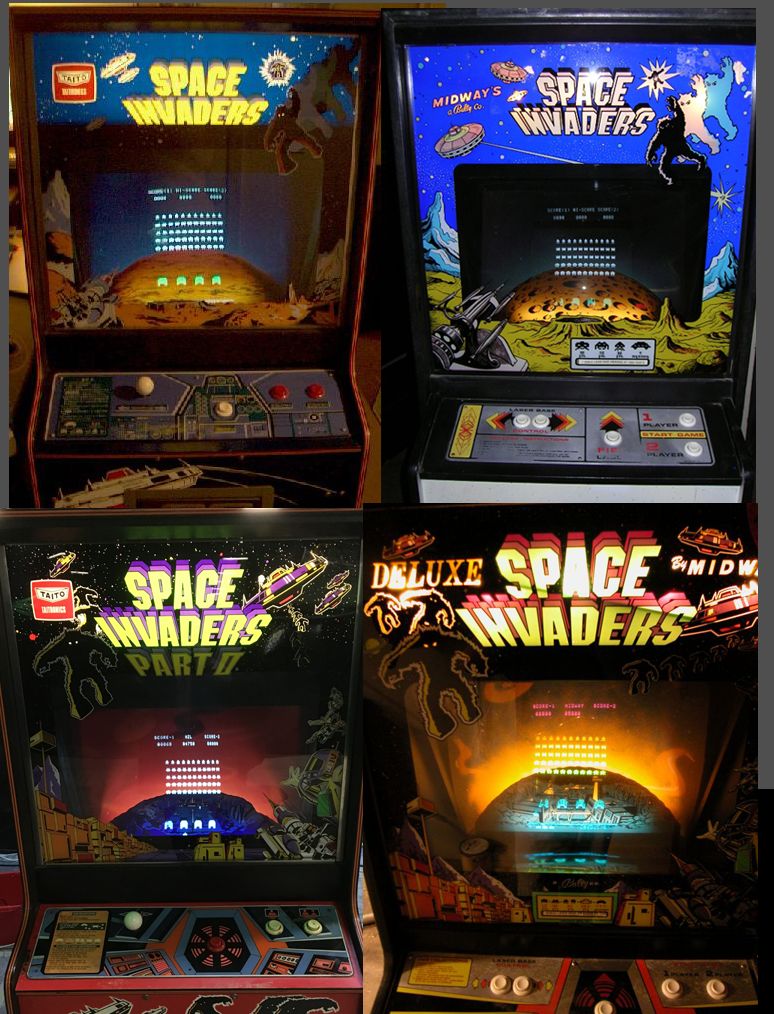
This presentation, along with the detailed marquee and cabinet art, gave an impression of quality and sophistication that wasn't possible in the home. Atari 2600 games came in flimsy cardboard boxes. The manuals were usually a few pages of black-and-white information, with a perfunctory paragraph of story that failed to capture the imagination.3 The cartridges resembled 8-track tapes, already old-fashioned compared to Philips' increasingly high-quality cassette (and the futuristic compact disc just a few years later.) Everything about the Atari felt cheap, old, and disposable.
By 1980, arcades had Pac-Man, which featured monsters not unlike the titular space invaders, except that each one has a name and a distinct personality. The game had cutscenes conveying the basic outline of a story. There was a mythos around Pac-Man that no game on the 2600 could match. The home port of Pac-Man arrived in 1982, and it was a joke. It barely resembled the game that captured everyone's imagination. The only conceivable audience for it was children, who rarely (if ever) got to see the arcade version and thus didn't know any better. In their minds, they got to play Pac-Man whenever they wanted, instead of only on special trips to the arcade, and that's all they needed. They could look past the awful sound effects and flickery mess on the TV.
Pac-Man in arcades was already something of a relic, with its single screen of action, austere black background and intermittent music. That same year, Namco would also release Rally-X, with 4-way scrolling, multi-colored backgrounds and sprites, and persistent music, all technical feats that were impossible on the tech players could bring home. Sure, its relative obscurity compared to Pac-Man shows that the absence of these features wasn't a deal-breaker, but I figure these early advances still bolstered the reputation of the arcade as the place where you could find real video games.
Berzerk had digital speech in 1980. Donkey Kong offered multiple screens of action and more sophisticated cutscenes in 1981. Pole Position and Turbo showed us pseudo-3D first-person racing in 1982. Arcade games had a variety of novel control methods, like steering wheels, trackballs and multi-button arrays; at home, you were stuck with paddles to play Pong or a shitty joystick with one button (or a terrible-feeling membrane keypad on a controller with no comfortable way to hold.) The more arcade games evolved, the more childish and unsophisticated the home offerings looked.
Enough ink been spilled about the "video game crash" of 1983,4 so I won't harp on it here, but the upshot is that when Nintendo finally made a play for the US console market in 1985, they were keen to distance themselves from the home video game stink as much as possible: The NES was marketed exclusively as a toy for children. You bought it at Toys "R" Us! It came with a toy robot! Games where you stack colored blocks seem vaguely educational! Donkey Kong Jr. Math!
Despite the NES finally bringing some of the sophistication of arcade games into the home, adults had been too badly burned to care. Parents grudgingly bought their kids Nintendos, but stopped seeing video games as a legitimate form of entertainment. The reputation wasn't helped by the marketing, which adults would've been embarrassed to be associated with, or the poor translations that plagued many NES titles: I distinctly remember my parents verbally rolling their eyes at phrases like "THE TRUCK HAVE STARTED TO MOVE" in Metal Gear.5
There were other good reasons to market exclusively to children: adults often seemed happy to focus their attention on one game at a time, where children would constantly pester their parents to buy more. Kids are more susceptible to marketing, including scammy gimmicks like the Power Glove. Kids are rougher with the delicate electronic equipment, which drives bonus replacement sales. Kids wanted subscriptions to Nintendo Power and begged their parents to let them call the 1-900 hotline when they get stuck. To corporations wanting to hit the reset button on a fucked-up market, the pivot made too much sense.
US arcades by the late 80s had also become fully child-oriented, bringing in carnival-style games and ticket redemption systems to entice kids with toys and candy. The die was cast: video games would continue being for children until the launch of the Xbox in 2001, when the children who grew up with home video games had become adults who play video games. Unfortunately, for complicated reasons, these people never achieved proper adult maturity, and video games have been for emotionally stunted man-children ever since.
I'm kidding, of course: today video games are as diverse as they've ever been and the internet has helped create a million fractional markets, but when you look at where all the money in the "games industry" has been going for a quarter century and counting, a little cynicism is unavoidable.6
So why didn't this happen in Japan? Atari was barely a blip there, but they had their own trash, like the Bandai Arcadia7 and Sega SG-1000. Why didn't those consoles ruin video games? One reason is a difference of scale: the Arcadia sold about 25,000 units, and the whole SG-1000 family—including the Mark III (the one we know as the Master System8)—barely topped a million. Meanwhile, Atari sold thirty million 2600s. The bad home video games in Japan just weren't big enough to leave a mark.
Another possible explanation is the same reason arcades thrived so much longer in Japan than in the US: centralization. Arcades did well in dense population centers, because when you operate a niche business that depends on foot traffic, you need as many potential customers as possible. Tokyo is the most populous metropolitan area in the world, and Osaka is no slouch. Much more of the US population is spread out over a much larger area. Arcades could do well in New York and LA, but there might be only one location in all of Nebraska or West Virginia where it would make sense to open an arcade at all, and they'd probably be small and unable to keep up with the newest games. On the other hand, anyone with 200 bucks could drive to their local Sears and pick up an Atari, and a huge number of them did. For large swathes of the country, the Atari 2600 was video games.
So congratulations, Atari. You brought video games to the masses and then you destroyed them, along with yourself. The mummified corpse of the Atari brand still roams the earth to this day, exploiting gen-Xer nostalgia to sell them NFTs or some shit. Get fucked🖕
-
The handful of loathsome "adult games" on the platform nonwithstanding: I suspect the number of people who actually played these games is vanishingly small, and they only became noteworthy because of the distributors strategically farming outrage. ↩
-
I come off as too much of a hater in this paragraph, so for the record, the following Atari 2600 games are cool: Adventure, Bank Heist, Bump 'n Jump, Cosmic Ark, Cosmic Commuter, Escape from the Mindmaster, Haunted House, H.E.R.O., Mines of Minos, Pengo, Pitfall I and II, Pressure Cooker, Reactor, Riddle of the Sphinx, Secret Quest, and Yar's Revenge. ↩
-
There were notable exceptions: Activision usually put much more effort into their manuals, and Yar's Revenge came with a full-color 10-page comic (thanks to John for the reminder), but I don't think these were sufficient to change the general perception. ↩
-
Only in the US, only home console games, and mostly affecting Atari. Mattel and Coleco were both established toy brands with a diverse portfolio, and they each represented <10% of the US video game market at the time; it'd be more accurate to call it the "Atari crash". ↩
-
The idea of Metal Gear being a game for children probably seemed less weird in the 80s, with the cartoonification of R-rated movies rampant, and toy companies lining up to sell Rambo and Robocop dolls to 10-year-olds. ↩
-
Call of Duty 17 cost 700 million dollars to make. What if instead the same budget was used to pay 700 queer independent developers $100k a year for ten years to make whatever they want? Which world would be better off? (hint: there is no meaningful difference between having sixteen Call of Duty games and having seventeen of them.) ↩
-
Actually a licensed version of some American trash, brought to you by the hottest name in video games: Emerson Radio. ↩
-
The Mark III/Master System was good, I'm not lumping it in with the trash; Sega just wasn't able to compete with Nintendo on mindshare or number of games. ↩