Now that streaming TV has entered its late-stage enshittification era, one nostalgia-goggled sentiment I'm starting to see goes like this: "Cable TV wasn't so bad! We didn't know how good we had it!" I can't blame them; if you weren't a bill-paying adult in cable's heyday, it probably does seem humane compared to the modern streaming landscape. But I think this perspective lacks much-needed context.
Now, it's possible that there was a golden age of cable TV before my time in the 70s and 80s, I don't know, but I grew up in the 90s and briefly faced the realities of the cable bill as an adult in the early 2000s, and in this time cable TV was always bad. This is my perspective in the US: I don't know what pay TV is like in other places, but I can't imagine it's this bad.
Price
Cable TV cost somewhere in the neighborhood of $50-150 USD. It's impossible to give a more precise figure, because there was no clarity or transparency around cable TV pricing whatsoever. There are a number of complicated factors going into the bill, but the bottom line is that cable companies would charge you, individually, whatever they thought they could get away with. If there was a price increase, you would only know about it when it appeared without fanfare or explanation on your next bill.
Once you noticed that your bill had gotten too expensive, it was expected that you would call your cable provider on the phone and say you wanted to cancel. At that point, you would be transferred to a "customer retention specialist", a real job that people probably still do. The CRS would then do whatever they could to keep you from cancelling, and they were authorized to offer you increasingly attractive (but temporary) price breaks. If you were a long-time customer and persistent enough about canceling, they might even start offering you free months of service. The CSR gets paid on commission based on how many cancellations they're able to prevent, so their only goal is to get you off the phone but still on the hook for service. Whatever price break you're given is worth it to the cable company, because they know that you're less likely to have the energy or motivation to endure this humiliation ritual when your bill goes stratospheric again a few months from now.
A nasty side-effect of this game is that if you actually do want to cancel your service, it's nearly impossible. The CRS is incentivized to keep you on the phone for as long as it takes to break your will. If they attempt to haggle with you for 45 minutes and finally offer you 6 months of free service, you're likely to accept it just to get the fuck off the phone.1 At the end of the call, if you're still a customer, they win.
Content and ads
Cable companies typically offer a few "packages" of channels you can choose from for a lower price, but these packages are all engineered to exclude at least one channel you're going to want. They want you to pay the most money to get the complete package, so they make sure the typical family won't be satisfied with any of the less expensive options. Package A might exclude ESPN, package B might exclude Nickelodeon, and package C might exclude Lifetime, so at least one member of the stereotypical 2.5 unit nuclear family would be dissatisfied. Better just get the full service package.
At that point, you're paying full price for 50-100 channels even though you only watch 4 or 5 of them. You also don't get the super premium channels, like HBO and Showtime (and at one point Disney) unless you pay an additional fee for each one. I don't know for sure how much these channels cost historically, but it looks like they're currently around $15 extra, and as far as I can tell this price has been consistent since the 90s. No one I knew with cable in the 90s or 2000s had these premium channels.
So, you're paying up to $150 a month to watch 4 or 5 channels. Sure, that's not counting CBS and NBC and ABC and Fox, but you could've been watching those channels for free with an antenna. But the free channels are subsidized by ads; since you're paying such a high premium for those additional channels, at least the ads aren't as bad, right?
Bad news: The cable channels have always had just as many ads as the over-the-air channels. In some circumstances, even more: the standard amount of ad time is 16 minutes for every 44 minutes of programming. So at least a quarter of all TV you watched was ads. But when reruns of popular network TV shows like Friends, Seinfeld, The Simpsons, etc. were syndicated to cable networks, they would usually edit parts of the episode out (and, in later years, play them at a slightly faster speed) to cram in as many additional ad seconds as possible.
At least the premium channels you paid extra for didn't have ads, right? Nope, they did too. They would at least air their shows uninterrupted, but many of them stuck to the same 22-minutes-per-half-hour format as broadcast and basic cable networks. Some of them went slightly longer, but very few of them were exactly 30 minutes or exactly an hour, so you always had at least a few minutes of ads between shows. They were "in-house" ads, so for example on HBO rather than seeing commercials for Pizza Hut or Pop-a-Matic Trouble, you'd see ads for other HBO shows. But they're still ads, and I always rebuffed the notion that these somehow "don't count".2
Speaking of ads, any movie you watched on TV was ruthlessly edited for both time and content to accommodate ads. Ad breaks were awkwardly inserted, often with no thought given to the surrounding context. Chunks were cut out to fit the movie plus ads into the allotted schedule.
Also, anything the ad partners would deem too objectionable was censored. You couldn't say "fuck" on basic cable. Not because of FCC regulations: those rules only apply to the free OTA networks. This was voluntary self-censorship to placate the advertisers. You could be a grown adult with no kids paying out the ass for TV and you weren't allowed to hear the word "fuck" in the privacy of your own home because some corporations said so. Why was anyone ever okay with this?
Convenience
Up until the turn of the century, live TV was the only game in town. This means that if, in the middle of your favorite TV show you've been waiting all week to see, you get an important phone call or get sick or some other emergency crops up, you're out of luck. You may get lucky and see that episode again in reruns, but there were no guarantees of seeing it in a timely fashion. VCRs existed, but they were very expensive for a long time. Here's a few you might've been able to get in 1996:
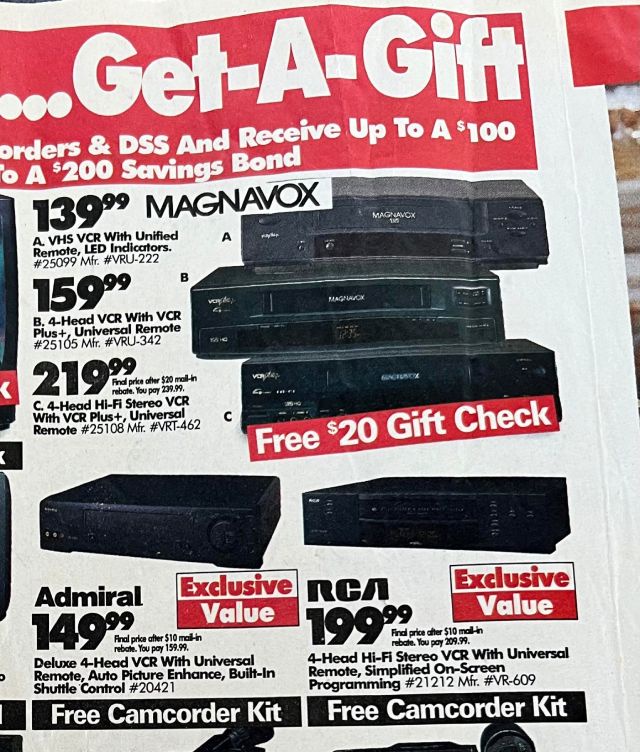
$139 for a bare-bones model, which wasn't obscene but also wasn't chump change, especially for 1996 (it's $291 in 2025 dollars.3) 1996 was nearing the end of the useful life for the VHS format; just a few years later they'd be supplanted by DVD and DVRs (more on those in a sec.)
But this price was probably reasonable for someone who could afford cable in the 90s, so suppose you did have a VCR. Did you set it up to record the show you're currently watching? Probably not. Programming a VCR was always a pain in the ass, and very few people did it unless they knew they weren't going to be able to watch a show live. Very few people recorded shows they were currently watching, except for fanatics who recorded every episode for their collection (and bless them, they're the only reason we can still watch a lot of shows that might otherwise have been lost to time.)
Digital video recorders (DVRs) came on the scene with the launch of TiVo in 1999. With DVRs, you could finally pause and rewind live TV, so you were no longer at the mercy of linear time. They could only record about 30 hours, and the average person had no way to back up the digital recordings, so you'd better hold on to your old VCR if you want to archive every episode of The Sopranos. It cost $400 plus an additional $10 a month for the TiVo "service". That's right, another monthly fee on top of your cable bill! You could also pay an extra $200 up front for a lifetime subscription, but $600 ($1152 in 2025) was out of reach for all but the most well-heeled cable-haver. You could also apparently get a Panasonic ReplayTV, which I had never heard of until I was looking up contemporary TiVo reviews, and not have the monthly fee; but it was a flat $600 at launch which was basically a wash.
Prices go down, as they always do,4 and DVRs eventually got cheap enough that they were built into the cable box you were forced to rent, but much like VCRs, they only became affordable near the end of their useful life, when the internet was replacing TV as the dominant cultural medium in the late 2000s.
Convenience?
Is streaming more convenient than cable? You can watch anything "on demand", without worrying about missing a new episode or needing to tape it, but also, the shows we want to watch can be taken offline at any time, for no reason. We can't watch them without an internet connection, and we increasingly have to pay extra if we want to watch on more than one device. With VCRs, we had the right to back up any show we wanted and watch it whenever we wish, on any screen with a VCR attached. You could have your own copy of a show for as long as the tape survived. Now, we don't own anything. Whether streaming is more convenient than cable depends on what you value, so I didn't want to gloss over it: this is one way cable might've been better. This right has been stolen from us.
Conclusion
There was no golden age of cable. Some individual cable networks had their golden ages, and if you were lucky enough to be a kid in the early 90s with Nickelodeon and MTV, or were able to watch weird and incredible movies on Bravo and IFC, or were into serious prestige dramas when The Sopranos and The Wire took off, I can see why you might remember cable fondly. But the good shows always existed in spite of, not because of, the platform. Cable as a service has always sucked ass, and the programming has fully converged on syndicated hits of the 90s and reality show monosludge. There's a good reason everyone was desperate to "cut the cord" in the mid 2000s.
In the early days of streaming, services like Netflix and Hulu were scrappy underdogs, like the cable networks once were. Where cable once took on the three-letter network5 oligopoly and won, streaming likewise set its sights on cable. They were able to take big swings and do new and exciting things, and this time, there was no local cable company in the middle to shit things up. We all watched Breaking Bad on Netflix and thought the golden age of TV had finally arrived.
But streaming is the new oligopoly, and it's eating itself too. This is capitalism: the biggest predators devour everything in sight until there's nothing left to eat but themselves. Whatever corporate media scavengers come for streaming's maggoty corpse will eat themselves in the end too. This is just the way of things. Scrape the paint off any golden egg of capitalism and you'll smell the unmistakable stench of a loss leader, and its color is always brown.
-
If you're ever in this situation with a cable company or any service provider, this is my winning strategy: tell them you're moving to another country. There is no argument or incentive they can offer that will counter this. If you feel bad about lying, remember that the entire financial arrangement is founded on the company's deception. ↩
-
The premium channels would occasionally offer a promotional "free weekend", where they were unscrambled for 48 hours so basic cable subscribers could see what they were missing. This was the only way I ever saw shows like Fraggle Rock on HBO or Welcome to Pooh Corner on Disney. These promotions did very little to convince me to subscribe, because I was a child. Sorry kid, try not being poor 🤷♀️ ↩
-
Inflation is a good way to ballpark the value of currency over time, but take it with a grain of salt, because it doesn't always reflect real consumer spending power. For that it's better to use something like the Big Mac index, which has increased nearly twice as much as inflation since 2000. ↩
-
Well, as they used to always do. ↩
-
ABC, CBS and NBC, the "big three" networks that had a stranglehold on TV for almost 50 years. ↩
It's true! Although used VCRs were around as well which made things a bit cheaper, and people didn't toss perfectly good electronics as much since you could sell them, and didn't toss imperfect electronics since you could /sell them for parts/. And you could record over other VHS tapes, that means you could buy an old crappy tape used from the rental store to archive your own crappy recording! With tracking lines all over it instead of MPEG compression blockiness/stuttering. Near the end of life for VHS I got a couple of advertisement tapes in the mail. We did not know how good we had it. Or rather how bad it could get. Took a lot of manufacturing 'refinements' to make it so hard to use used things. And DMCA.
If I keep going, the comments section will become a Cory Doctorow blog post.