What the heck even is time?! April 13 was the one-year anniversary of the start of my full-time Linux journey, and I haven't talked about it in awhile. Well, I'm happy to report that no news is good GNUs. It's remained the most stable Linux experience I've ever had and it's not even a contest. I've barely felt the need to shut down or restart my computer: I put it into "hibernate" when I go to bed and wake it up when I get home from work the next day. It resumes with my desktop exactly as-is almost instantly. Doesn't even break a sweat. Memory leaks seem to be a thing of the past.
Debian 13 was released last August, but I haven't seen a need to update yet. I'll let you know if/when that changes. I've been updating software piecemeal as needed.
It's been a great development environment. Hero's Last Hurrah was made entirely in the Steam release of RPGMaker 2003 running under Proton. I initially had issues getting the midi music to play, and one of the Linux tools needed to package the game for EasyRPG didn't work properly. I posted about my issues in the jam troubleshooting thread, and received some amazing support from two of the other participants. For the music, Camellia recommended Qsynth, and it worked great. It was a little fiddly: occasionally the music would corrupt and become unlistenably crunchy, and to fix it I had to go into the Qsynth settings, switch to another midi backend (or whatever) and switch back. It was a minor annoyance, and it was only an issue during development; for playing games, EasyRPG has built-in midi support. (But frustratingly, they make you provide your own soundfont for the desktop player, and the soundfont they provide for the web player sounds bad; I had to hunt down a good one on my own.)
As for the broken utility, Emi went to the trouble of re-creating it in python for me, which I'm very grateful for. Bizarrely, the tool provided gave me an error stating that it requires GLIBC version 2.38, which is so cutting-edge that it's not even in Debian 13. GLIBC is one of those core libraries that's so fundamental to making Linux work that you can't just update it in situ, the whole OS has to sort of be built around it. I would've had to either compile the OS myself or switch to a distribution that includes it (like Arch), either option being way above my pay grade. It's baffling that the tool has this requirement, since as far as I can tell, all it does is look for some files in its own folder and some subfolders, then generate a .json that says where those files are. It could probably be done in bash. Or, well, a 67-line python script! Huge thanks to Emi, without its help I wouldn't have been able to make it playable in a browser, and I'd hate for it to be less accessible.
I still haven't found an image editing stack that works as well as Paint.net and Irfanview, and I probably never will. The developers of Paint.net seem to have no interest in ever making a linux version, it's too dependent on .net libraries to work under Wine, and nobody can port it because it's not open-source. It's a bummer, but there's no point kvetching about it, just gotta do the best I can with what I have.
HLH uses stock RM2k3 assets almost entirely, but I did need to make some edits and tweaks. For that I used Pixelorama, which worked great, but RPGMaker 2003 has a quirk that made sprite editing a massive headache.
RM2k3 wants its sprites in a very specific format: 8-bit (256 color) PNG with the transparency color on palette entry 0. There's no alpha channel support, so spritesheets use solid color backgrounds for transparency: lime green for in-world character sprites, bright magenta for objects, and sea foam green for battle sprites.
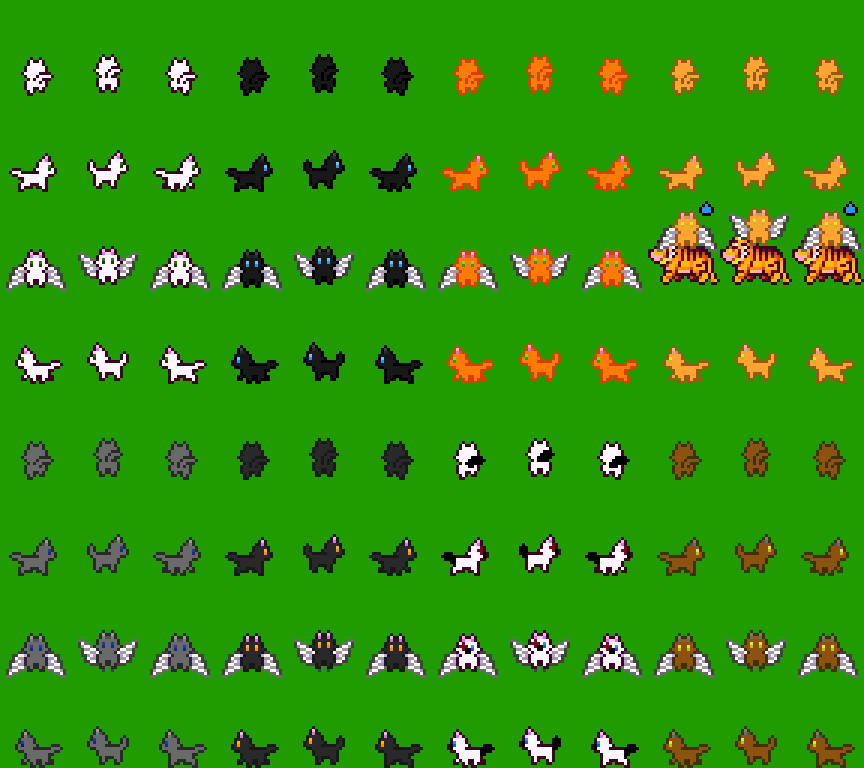
Maybe I'm dense, but I couldn't figure out how to edit in Pixelorama without fucking up the palette. Even if all I do is change one pixel to another color that exists in the palette, the version I save will shuffle the palette order and break the transparency.
The way I had to work around this is very dumb. Irfanview does work under Wine, albeit in a slightly janky state. It worked enough for what I needed to do. Here's the process: Open one of the vanilla sprite sheets. Export the palette to a .pal file. Edit the sprite sheet in Pixelorama. Save it as a new file. Open the new file in Irfanview. Decrease the color depth to 8-bit. Import the palette from the .pal file I saved previously (which remember, is all the same colors, I just need to put them back in the right order.) Then, finally, save the edited spritesheet again and import it back into RM2k3.
I'm actually not sure if this process would've been much easier under Windows? I think paint.net can edit the files non-destructively, but I've never had to pay that much attention to palette entries before. At the very least, Irfanview wouldn't have taken 20 seconds to load each time I needed it.
Anyway, other problems I've had are so minor they're barely worth mentioning. The version of FileZilla on the apt store had a bug where the program would crash if, during a rename operation, you pressed the numpad enter key instead of the regular one. I manually installed the latest version and now it's fine.
Sometimes programs don't adapt properly to the desktop dimensions if I go from using the built-in screen to my 21:9 monitor. I almost never use my laptop portably, and when I do, I've gotten used to closing open programs when I hibernate it. If I forget, I just need to alt-F4 and open it again.
I've yet to figure out how to make numlock stop occasionally turning itself off. I've learned to check and make sure the light is on before I use the numpad.
I'm struggling to think of any other quibbles. Onto the positives:
Mesen covers most of my emulation needs. For everything else, there's MasterCardBizhawk. Small/old Windows games usually work fine under Wine or Proton, old ones often better than they would on modern Windows. My gamepad works fine in almost all cases, I don't know what my problem was before. Maybe I was accidentally connecting in xinput mode instead of dinput? Or vice versa? Regardless, AntiMicroX works every bit as well as JoyToKey when I need to do custom remapping.
For basic data wrangling, Gnumeric is fast and functional. For heavier-duty number crunching, LibreOffice Calc is fine. LO Writer is fine for word processing. Someone who does complex spreadsheets or documents for a living might have more granular needs that can only be met by Word or Excel, but for my casual home office needs there's essentially no difference.
One of my Windows can't-live-without tools is Everything, the ultimate file search utility. On Linux, FSearch is almost exactly as good. It takes slightly too long to re-build the file index every time, but it's way better than nothing.
For web browsing I've switched to LibreWolf. There's nothing specifically Linux-y about this, I probably would've made the same decision if I was still on Windows, but they go well together. It's a Firefox fork that attempts to strip out as much of the bullshit as possible. It takes privacy extremely seriously, and there are some settings you'll need to disable if your paranoia level isn't cranked to 11, but it's been worth the initial friction. I never have to deal with surprise "AI" updates, or major UI changes, or ads for Mr. Robot, or undisclosed opt-out "studies",1 or any of the unfeatures Mozilla constantly nags people to use (like whatever "Pocket" is.) LibreWolf also has uBlock origin built-in, which is nice. I occasionally encounter sites that don't work: legacy TV/movie streaming sites in particular sometimes refuse to believe my browser exists. Some sites are convinced such a weird browser must actually be a robot. I have Chrome installed for those edge cases, but 9/10 times LibreWolf is all I need.
I'm sure there are other observations but these are the ones coming to mind. The future for Windows (and Microsoft in general) is looking bleaker than ever, and I'm happy there's an alternative that works more or less the way I need it to. There may be more to say later if the Debian team ends up drinking the slop-aid,2 but for now I'm grateful for the functional, stable and secure computing environment they provide, and I hope I'll get to continue enjoying it for a long time to come 🦝
-
i.e., spyware. ↩
-
Their current stance seems to be "we're not ready to declare a stance", which at this stage doesn't bode well. ↩
This is the kind of practical stuff I love. RPGMaker 2003 seems very crufty about the palette. I know GIMP (... who named that) GNU Image Manipulation Program also does .PAL pallettes. But it's pretty big, you might actually be going faster emulating windows.