I wasn't sure if I'd post about this every week, but I guess as long as I keep participating, I might as well. Every Monday I'll post my caption, what I think about the finalists, and whether I'm happy with my performance.
What is "funny"?
In my previous post, I doubted the possibility of writing a truly funny caption, but I didn't really get into why or how I'm defining "funny", so I thought I should explain where I'm coming from.
"Funny" is one of those rare concepts that's 100% subjective, but within that subjectivity has a clear binary definition: a thing is funny if it makes me laugh. This is an incredibly high bar for a single-panel comic with a caption; by this criteria, I don't know if any New Yorker cartoon has ever been funny (to me, subjectively.) And that's okay! Even if it doesn't make me laugh, it can still be witty, and wit is worth a lot on its own. "Funny" is just the highest bar to aim for, the holy grail, the white whale, the unattainable goal that keeps us reaching for the stars.
With a three-panel comic, you have three distinct phases to work with: premise, complication/rumination, punchline. It resembles a traditional joke structure. You can prime the reader to expect one thing and then deliver the opposite.
A single-panel comic is comedy writing on hard mode. You have to think about how the reader will approach the comic, predict how they interpret it, and anticipate their expectations before you can subvert them. I don't think wit is enough on its own: there needs to be some incongruity between drawing and caption. You almost have to give the reader a puzzle to solve. They have to not quite get it at first; the laugh comes after they make the connection.
This is really dang hard! That's why "funny" or "winning" isn't where I expect to land; "somewhat witty" and "original" is a perfectly acceptable outcome.
So with that established, here's the comic and my submission:
Cartoon #985
“The ASCAP terms weren't bad, but you do NOT want to mess with the ASPCA.”
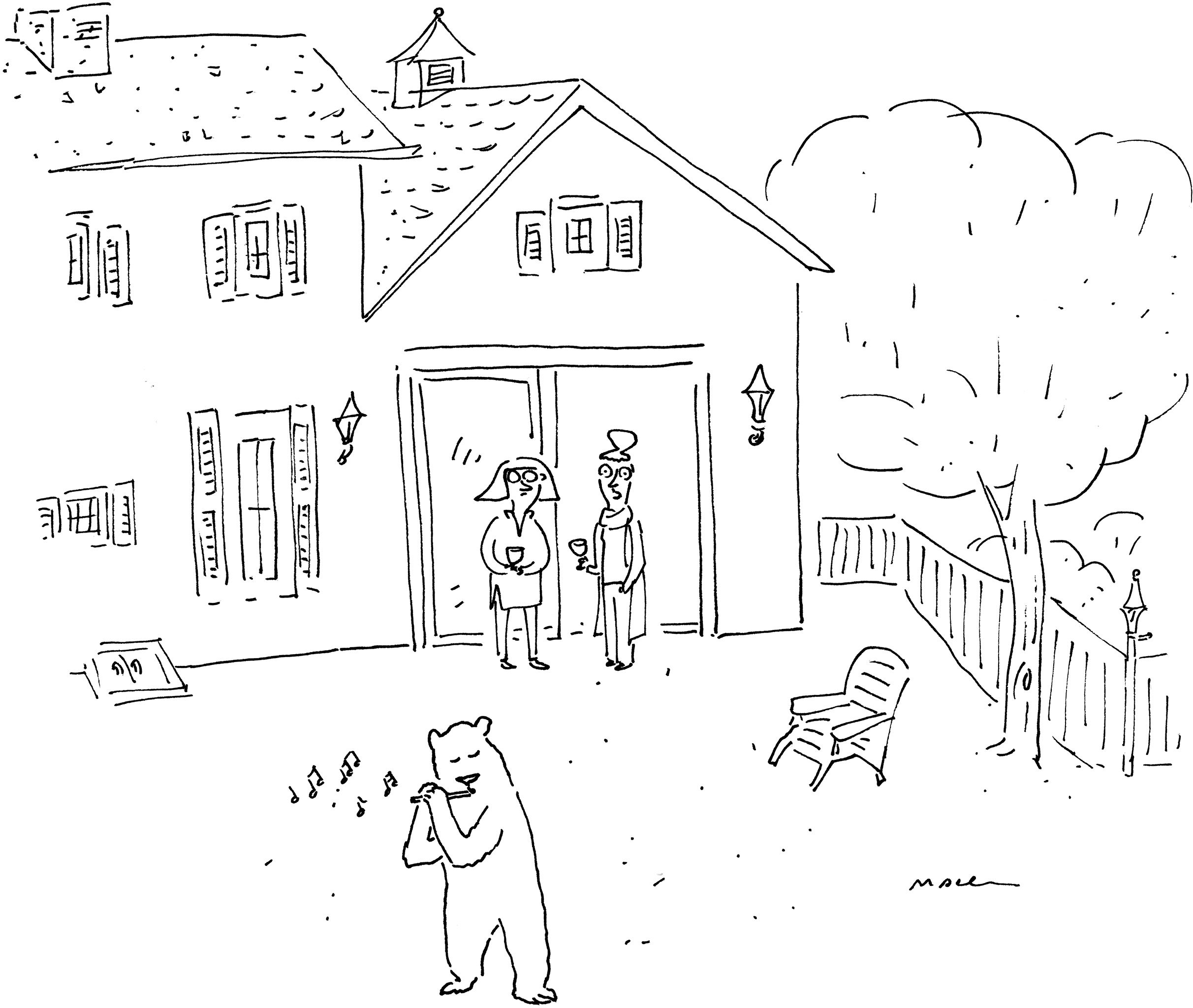
The first expectation I wanted to subvert was that the presence of the bear is in any way surprising, unwanted, confusing or fearsome. That's the natural default reaction when you see a bear playing a flute in your back yard, but the people in the drawing have neutral expressions. I had free rein with the text to give them any mild emotion I wanted, so I used this to my advantage.1
The vast majority of entries went with the "this is odd" approach, so you can see how the goals of "be funny" and "be original" are aligned: what if the bear playing the flute isn't a surprise at all? What if the person who lives there hired the bear to play? I wasn't the only one with this thought, but I was one of a few. Being contrarian isn't automatically going to make you funny, but it's a good first step.
So given that hiring a bear to play the flute is mundane, what's something surprising about this premise? The core of my joke is that ASCAP and ASPCA are two organizations that normally have nothing to do with each other but have nearly identical acronyms. ASCAP (the American Society of Composers, Authors and Publishers) is a nonprofit that helps songwriters get paid for public performances of their work; the ASPCA (American Society for the Prevention of Cruelty to Animals) does what the name suggests. Hiring a bear to play the flute is one of the few unlikely scenarios in which you'd have to deal with both.
Among the hundreds of captions I rated, I only saw one that used a similar idea: “I don't know whether to call ASPCA or SAG-AFTRA.” In my opinion, this is weaker than mine in three ways: 1) It assumes the presence of the bear is unexpected, which is expected; 2) The acronyms aren't as similar; and 3) The trade union probably does help composers, but it's much more strongly associated with actors. It's more of a logical leap.
The finalists
Finalist 1
“I tried making myself bigger and waving my arms, but it just thought I was conducting.”
This one's the least bad of the three, and the one I voted for. I did see this idea expressed a few times, but this was the most concise version, and the mental image of an orchestra conductor waving their baton to scare off a bear is amusing.
Finalist 2
“The first song was too long; the next one was too short. But this one is just right.”
There were plenty of "Goldilocks and the three bears" references, so this one didn't stand out, and it's also too wordy. If I was going to vote for a caption like this, it would've been one that left the first two parts implied: "...but this song is juuuust right!"
Finalist 3
“A fife or a piccolo? That’s your first question?”
There were a ton of captions that tried to play with the reader's assumptions about the instrument: your first thought is "flute", but did you know that fifes are piccolos are also held sideways? This feels more like flexing trivia knowledge than making a joke, and it's especially unfunny here because this isn't how people talk. Try to imagine it with the first half of the dialogue:
😲 "Wow, that bear's playing a fife! Or wait, is it a piccolo?"
🤨 “A fife or a piccolo? That’s your first question?”
See, why would the second speaker have repeated the person's question back to them? It's stilted and unnatural. It would've been fine in a 3-panel strip (1. setup, 2. awkward silence, 3. "That's your first question?") but forcing it into a one-panel cartoon doesn't work.
Why am I not a finalist?
Here are six possible explanations:
1. My caption isn't as witty as I think
Despite the unique premise, maybe it's still neither funny nor witty enough to move the needle. Maybe I'm overestimating how good it is. The only way I can fairly assess this is with outside feedback, so if you want to share your opinion, you can comment anonymously below or email bluelander@tutanota.com.
2. The selection process is a black box
I have no idea how the ratings work. I don't know how many submissions there were. I don't know if the captions you're shown are completely random or if there's some algorithm involved. I didn't see my caption while I was rating, but I don't know if that's because it was removed from the pool of entries, because the system is designed not to show people their own captions, or because I was just unlucky. Maybe no one even saw my entry. How could I know?
3. People don't know what ASCAP is
Most people who aren't involved in the music or entertainment industry in some capacity have no reason to know what ASCAP is. I figured New Yorker readers are sponge-brained enough to be aware of it anyway, but people who participate in the contest aren't necessarily the same ones who read the magazine. Also, the readership is international, so many of them have even less reason to know about a US rights organization.
4. The acronyms are too different
ASCAP is a proper acronym you pronounce like a word, ASPCA is an initialism where you say each individual letter. That makes the joke more visual and abstract than if they sounded similar in your head, so people are less likely to find it funny.
5. People have different assumptions about the organizations
I figured a bear playing the flute for whoever happens to walk by wouldn't be a big priority for ASCAP, and if they required any royalty fees at all they'd be minimal. I also figured the ASPCA would take bear labor rights seriously and it would take a lot of time and effort to get their approval. Maybe I had it backwards; maybe people think ASCAP would've put the screws to her, and they resented the implication that ASPCA would be difficult to work with. In hindsight I think the other way around is slightly stronger, but I don't think it would've made a huge difference.
6. The selection process isn't favorable for captions you need to think about
Rating hundreds of nearly identical captions does something weird to the brain: I experience a kind of semantic satiation that makes it harder to tell if anything is clever. It's hard to catch when a submission is doing something different. It's easy to assume a caption you don't immediately understand is as bad as the ones surrounding it, or to click "not funny" by pure reflex. I think the more "puzzle"-like submissions are at an automatic disadvantage.
Conclusions
I think my caption was better than any of the finalists, and why mine didn't make it is probably some combination of 2, 3, and 6. There's no point feeling bitter without knowing more about the selection process. I wish the New Yorker was more transparent about how many entries they receive and how the voting works. For all I know, they receive a million submissions a week and have to pick 100,000 at random for the final pool just so their system could handle it. For all I know, my entry got caught in some kind of spam filter. For all I know, the rating is just a suggestion and the editors have final veto power; it's impossible to know for sure. In the future, I'll try to just assess my entry and the finalists on their own merits. Without a more transparent selection process, I really don't think there's any insight to be gained by comparing them.
Did you submit a caption? Are you happy with it? Do you have thoughts about my entry or any of the finalists? Comments are always open. Ratings for cartoon #986 are live. I'm pretty happy with my submission. I don't have any ideas for #987 yet, but I have a week to think about it. I'll see you next Monday 🦝
-
Contrast this with the rabbit comic from last time, where the artist clearly looks nonplussed and the commenter clearly looks annoyed or doubtful. It requires a different approach. ↩